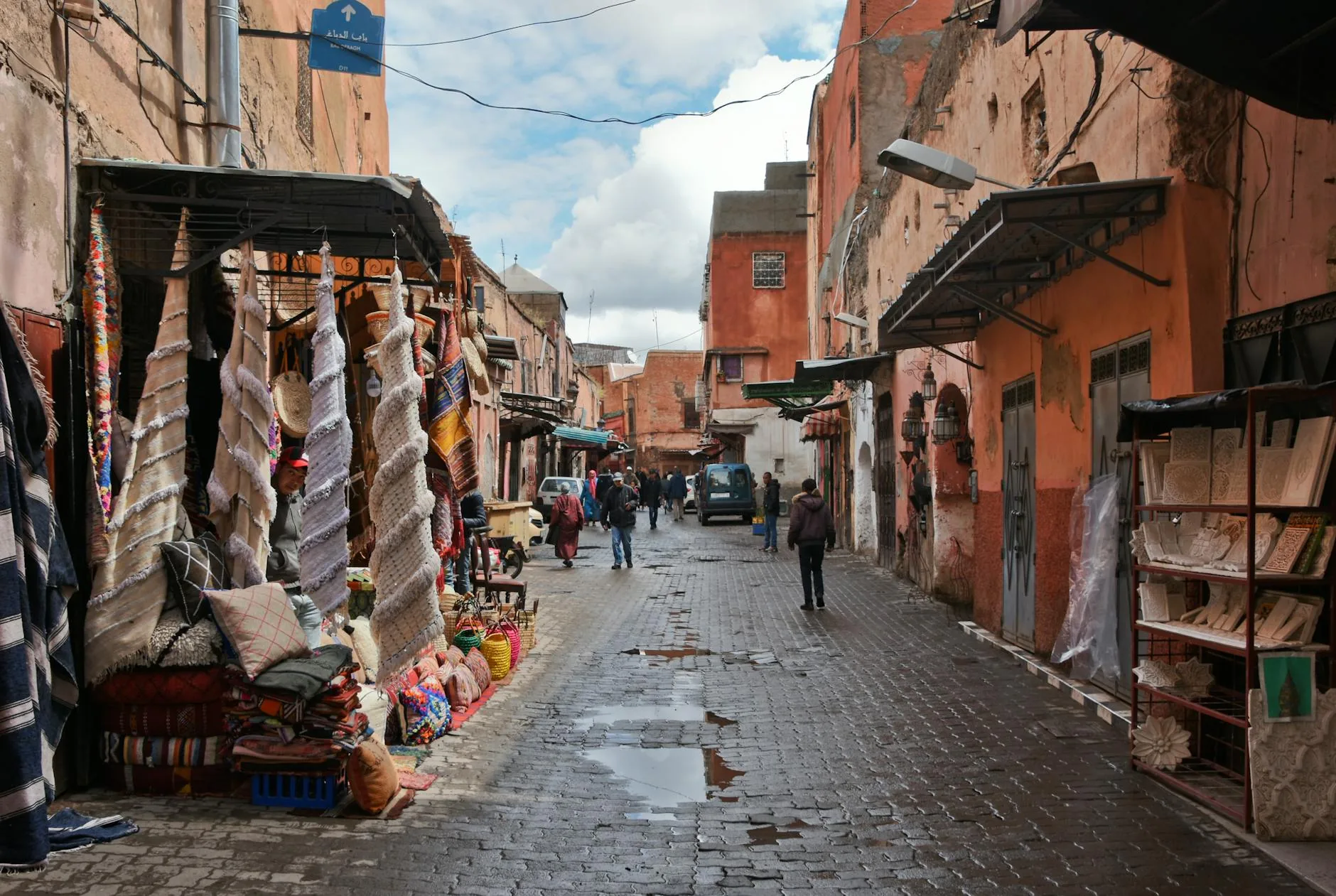
View of the Djemaa el-Fna square in Marrakech, Morocco

Moving to Morocco

The gateway to Africa, 2 hours from Paris

Read the guide
North AfricaDirham (MAD)300+ days of sunshineVisa-free 90 daysRabat / Casablanca-45% vs Paris

Factsheet: Morocco

Morocco is a North African kingdom of 37 million inhabitants, bordering Spain (14 km via the Strait of Gibraltar at Tangier), just 2 to 3 hours by air from France. A de facto French-speaking country, open to the Atlantic and the Mediterranean, crossed by the Atlas Mountains and bordered by the Sahara, it offers an exceptional diversity of landscapes and lifestyles. With a cost of living up to 45% lower than Paris, renowned gastronomy, and a massive French community (~55,000 registered at the consulate), Morocco is the leading French expatriation destination outside Europe.

πŸ‡²πŸ‡¦
Morocco
The gateway to Africa, 2 hours from Paris
Capital
Rabat (expats: Casablanca, Marrakech, Agadir)
Official language
Arabic / Amazigh (French widely spoken in business and social life)
Currency
Moroccan Dirham (MAD), 1 EUR β‰ˆ 10.8 MAD
Population
~37 million inhabitants
Timezone
UTC+1 permanent (no daylight saving time)
πŸ‡ͺπŸ‡Ί European Union
No
Digital nomad visa
No (visa-free 90 days)
Cost of living (vs Paris)
~45 to 50% cheaper

Why choose Morocco?

Morocco combines rare assets: geographic proximity to France, the French language omnipresent in daily and professional life, a very low cost of living, sunshine, diverse landscapes, and human warmth. It is the most accessible destination outside Europe for a French expatriate. Here are the six main reasons tens of thousands of French people choose Morocco every year.

✈️
Proximity to France
Casablanca is 2h30 from Paris, same time zone in winter (UTC+1), only one hour difference in summer. Frequent returns and multiple low-cost connections from major Moroccan cities.
πŸ—£οΈ
Complete French-speaking environment
French is the language of business, administration, private clinics, and much of social life in major cities. No language barrier when settling in.
β˜€οΈ
Quality of life and sunshine
Over 300 days of sunshine per year, exceptional gastronomy (tagines, couscous, pastilla), legendary warmth and hospitality. A unique art of living between East and West.
πŸ’°
Very low cost of living
45 to 50% cheaper than Paris overall. Accessible rents, very affordable local dining (tagine at 4-6 EUR), inexpensive public transport. A budget of 1,000-1,500 EUR/month is enough to live comfortably.
πŸ–οΈ
Diversity of environments
Atlantic Ocean, Mediterranean Sea, Atlas Mountains (skiing in winter), Sahara Desert, and historic imperial cities: Morocco offers a variety of living environments unmatched at this distance from France.
πŸ‘₯
Massive French community
Over 55,000 French nationals registered at the consulate, actual community likely exceeding 100,000 people. French schools, media, associations, and very active business networks in Casablanca and Marrakech.

Visa & Residence

Morocco is one of the most accessible non-European destinations for French nationals: no formalities are needed for stays under 90 days. Beyond that, a residence card is required. There is no official digital nomad visa, unlike some other popular destinations.

Visa-free 90-day stay

French nationals can enter and stay in Morocco without a visa for up to 90 consecutive days. No prior formalities are needed: a passport is sufficient at the border. This freedom of movement makes it an ideal destination for testing life on the ground before settling permanently.

Duration
90 consecutive days
Min. income
No proof of income required
Timeline
Immediate, passport is sufficient
Target
Free

Registration Card, beyond 90 days

To stay legally beyond 90 days, you must obtain a Registration Card (Carte d'Immatriculation, foreign residence card) issued by the Moroccan authorities (Bureau des Etrangers at the prefecture). The application includes: proof of address in Morocco, proof of stable income or resources, apostilled criminal record extract, identity photos, and an application form. The first card is valid for one year, then renewable for multi-year periods.

Duration
1 year then multi-year
Min. income
Proof of stable resources
Timeline
1 to 3 months processing
Target
~50-100 MAD in stamps (~5-10 EUR)
Border runs: not recommended. Some expatriates make regular trips to Spain or Portugal to renew their 90-day period. This practice is not a legal long-term solution and may result in being denied entry to Morocco. For any permanent settlement, the Registration Card is essential.

Cost of living

Morocco remains 45 to 50% cheaper than Paris in overall cost of living. This is one of the most decisive advantages for French expatriates. Local dining is particularly inexpensive: a tagine in a popular restaurant costs 4 to 6 EUR. Housing represents the most variable portion depending on the city chosen.

Estimated monthly budget: 1,000 – 1,800 EUR/month (Casablanca/Marrakech) - 800 – 1,400 EUR/month (Agadir/Tangier)

Expense Monthly amount
Rent, 1-bed, city center (Casablanca/Marrakech) 400 – 700 EUR
Rent, 1-bed, city center (Agadir/Tangier) 250 – 450 EUR
Groceries 150 – 280 EUR
Restaurants (local) 60 – 120 EUR
Transport (taxi / Uber) 30 – 60 EUR
Fiber internet 15 – 25 EUR
Private health insurance 40 – 100 EUR

πŸ“Š Taxation

Moroccan taxation is often poorly understood by French expatriates. It is progressive on Moroccan-source income and presents an interesting feature for expatriates: foreign income not remitted to Morocco is in principle exempt in common practice. The France-Morocco tax treaty of 1970 avoids double taxation.

Progressive income tax: 0 to 38% on Moroccan income
Brackets: 0% up to 30,000 MAD/year (~2,780 EUR), 10% (30,001-50,000 MAD), 20% (50,001-60,000 MAD), 30% (60,001-80,000 MAD), 34% (80,001-180,000 MAD), 38% above 180,000 MAD (~16,670 EUR).
Corporate tax: 10 to 31% depending on revenue
10% for revenue below 300,000 MAD, 20% (200,000-1M MAD), 26% (1M-100M MAD), 31% above 100M MAD. Dividends: 15% withholding tax.
Foreign income not remitted, exempt in practice
Foreign-source income not transferred to a Moroccan bank account is generally exempt. This common practice is not legally guaranteed and rules may evolve. Consult a specialist in Franco-Moroccan tax law before establishing your residency.
France-Morocco tax treaty (1970)
Double taxation avoided between France and Morocco since the 1970 treaty. An expatriate who resides more than 183 days in Morocco becomes a Moroccan tax resident and is in principle taxable on worldwide income.
Strict exchange controls
The Moroccan dirham is not freely convertible. Repatriation of funds to France is regulated by the Office des Changes. Large transactions require specific documentation and authorizations.

πŸš€ For entrepreneurs

Morocco offers a functional entrepreneurial framework but is not the optimal jurisdiction for international tax optimization. Local structures are suited for activities targeting the Moroccan market, not necessarily for foreign-source income from international clients.

Moroccan LLC (SARL)
Minimum capital of 10,000 MAD (~900 EUR), formation in 10 to 15 days via the Regional Investment Center (CRI). Corporate tax 20-31% depending on revenue. Dividends subject to 15% withholding tax.
Auto-entrepreneur
Simplified regime, maximum revenue of 2 million MAD/year for services (~185,000 EUR). Flat tax of 2% on revenue. Ideal for modest activities and starting out locally.
No entrepreneur visa
No specific entrepreneur visa exists in Morocco. Setting up a local company does not automatically grant a residence permit. The Registration Card must be obtained separately.
Common strategy among French expatriates
Many French people who expatriate to Morocco set up their company in Estonia (e-Residency, 0% corporate tax on reinvested profits) or Dubai (free zone, 0% tax) and live in Morocco as non-tax residents in their company's country.

❀️ Healthcare

Moroccan private clinics offer good quality care in major cities, at rates much lower than France. Public hospitals should be avoided by non-residents due to insufficient comfort and reliability levels. International health insurance is strongly recommended.

Leading private clinics
Clinique Internationale (Casablanca, private sector reference), Polyclinique du Littoral (Casablanca, specialized care), Clinique Agdal (Rabat, quality and proximity). Private clinic consultation: 20-50 EUR. Dental care up to 3 times cheaper than in France.
Medications 40 to 60% cheaper
Medications are significantly cheaper than in France, widely available in pharmacies. The CNOPS (Moroccan social security) is accessible to employees under a local work contract but does not cover freelance expatriates.
International insurance essential
AXA Expatriate and Cigna Global are recommended. Expect 50 to 150 EUR/month depending on age, coverage level, and deductible. Insurance covers care in Morocco, medical repatriation, and care during stays in Europe.

Where to live

Morocco offers very different atmospheres depending on the city. Casablanca is the economic capital and concentrates professional opportunities. Marrakech attracts lifestyle profiles and digital nomads. Rabat is calmer and more administrative. Agadir and Tangier appeal with their seaside location and accessibility.

Casablanca
Casablanca
Business hub, expatriates from international companies, large French community. Key neighborhoods: Gauthier, Maarif, Ain Diab. Rent 400-700 EUR/month.
Best for: The economic capital
Marrakech
Marrakech
Tourism, riads in the medina, modern Gueliz and Hivernage. Strong nomad scene, gourmet restaurants, 300 days of sunshine. Rent 350-600 EUR/month.
Best for: Lifestyle and digital nomads
Rabat
Rabat
Political capital, calm and residential living environment, less international than Casablanca. Ideal for families. Rent 300-500 EUR/month.
Best for: The administrative capital
Agadir
Agadir
Atlantic coast, beach, surf, calm. Very popular with families and retirees. Modern and accessible city. Rent 250-400 EUR/month.
Best for: Surf, sunshine, and families
Tangier
Tangier
14 km from Spain (Strait of Gibraltar), cosmopolitan, booming economically. Ideal for profiles straddling two continents. Rent 250-450 EUR/month.
Best for: The gateway to Europe

Drawbacks to know

πŸ“œ
Regulatory instability for foreigners
Rules concerning foreigners (visa, residency, work rights) can change without notice. The absence of a stable nomad visa creates legal uncertainty for remote workers staying long-term.
πŸ’Έ
Strict exchange controls
The Moroccan dirham is not freely convertible. Repatriation of funds to France is regulated by the Office des Changes. Large transactions require specific documentation and authorizations.
πŸŒ‹
Real seismic risk
The Al Haouz earthquake of September 2023 (magnitude 6.8, nearly 2,900 deaths) reminded of the reality of seismic risk in Morocco, particularly in the Marrakech-Atlas region. This risk should be factored into housing choices.
🐌
Bureaucracy and administrative slowness
Obtaining the Registration Card, opening a bank account as a foreigner, and setting up a company can take several weeks to several months. Patience and a good local network are essential.
🌑️
Extreme summer heat in the south
Inland areas (Marrakech, Ouarzazate, Draa Valley) experience temperatures exceeding 45C in July-August. The Atlantic coast (Agadir, Essaouira) remains much more temperate thanks to trade winds. Choose your residential area carefully based on heat tolerance.

Frequently asked questions

Do you need a visa to settle in Morocco from France? +
For stays under 90 days, no visa is needed: your French passport is sufficient. Beyond 90 days, you must obtain a Registration Card (Carte d'Immatriculation, residence permit) from the Bureau des Etrangers at the prefecture of your place of residence. The application includes proof of Moroccan address, proof of income, apostilled criminal record extract, and identity photos. Processing time is 1 to 3 months. There is no official digital nomad visa in Morocco to date.
Is Morocco a good destination for tax optimization? +
Not directly, no. Morocco is not the most optimized jurisdiction for international entrepreneurs: corporate tax ranges from 20 to 31%, and dividends are subject to a 15% withholding tax. However, foreign income not remitted to Morocco is generally exempt in practice thanks to the territoriality principle. The most common strategy among French expatriates in Morocco is to set up their company in Estonia (e-Residency) or Dubai, and live in Morocco for the quality of life and low cost. Consult a tax specialist before making any decision.
Can you open a Moroccan bank account as a foreigner? +
Yes, but the procedure can be lengthy and requires valid Moroccan proof of residence (registered lease, Registration Card, or any official document). The main local banks (Attijariwafa Bank, CIH Bank, BMCE, Banque Populaire) open dirham accounts for foreign residents. A foreign currency account (convertible account) is an option for receiving and holding funds in euros. Note that the dirham is not freely convertible: large transfers to France are regulated by the Office des Changes.
What is the best city to expatriate to in Morocco? +
The answer depends on your profile. Casablanca is the natural choice if you work for a multinational: it is the economic capital with the largest French community. Marrakech suits lifestyle profiles, freelancers, and digital nomads. Rabat is ideal for families in a calm and secure setting. Agadir attracts surf, beach, and nature enthusiasts. Tangier appeals to those who want to stay close to Europe while enjoying Moroccan life.
Which health insurance to choose for living in Morocco? +
For most French expatriates in Morocco, international health insurance (AXA Expatriate, Cigna Global, Allianz Care) is the most suitable solution. It covers care in Morocco, medical repatriation to France, and care during your stays in Europe. Expect 50 to 150 EUR/month depending on age, coverage level, and chosen deductible. If you are employed under a local Moroccan contract, you contribute to CNOPS (mandatory Moroccan health insurance). For routine care in private clinics (consultation 20-50 EUR), expenses remain very manageable.

Explore other destinations

Compare with other countries that might suit you.