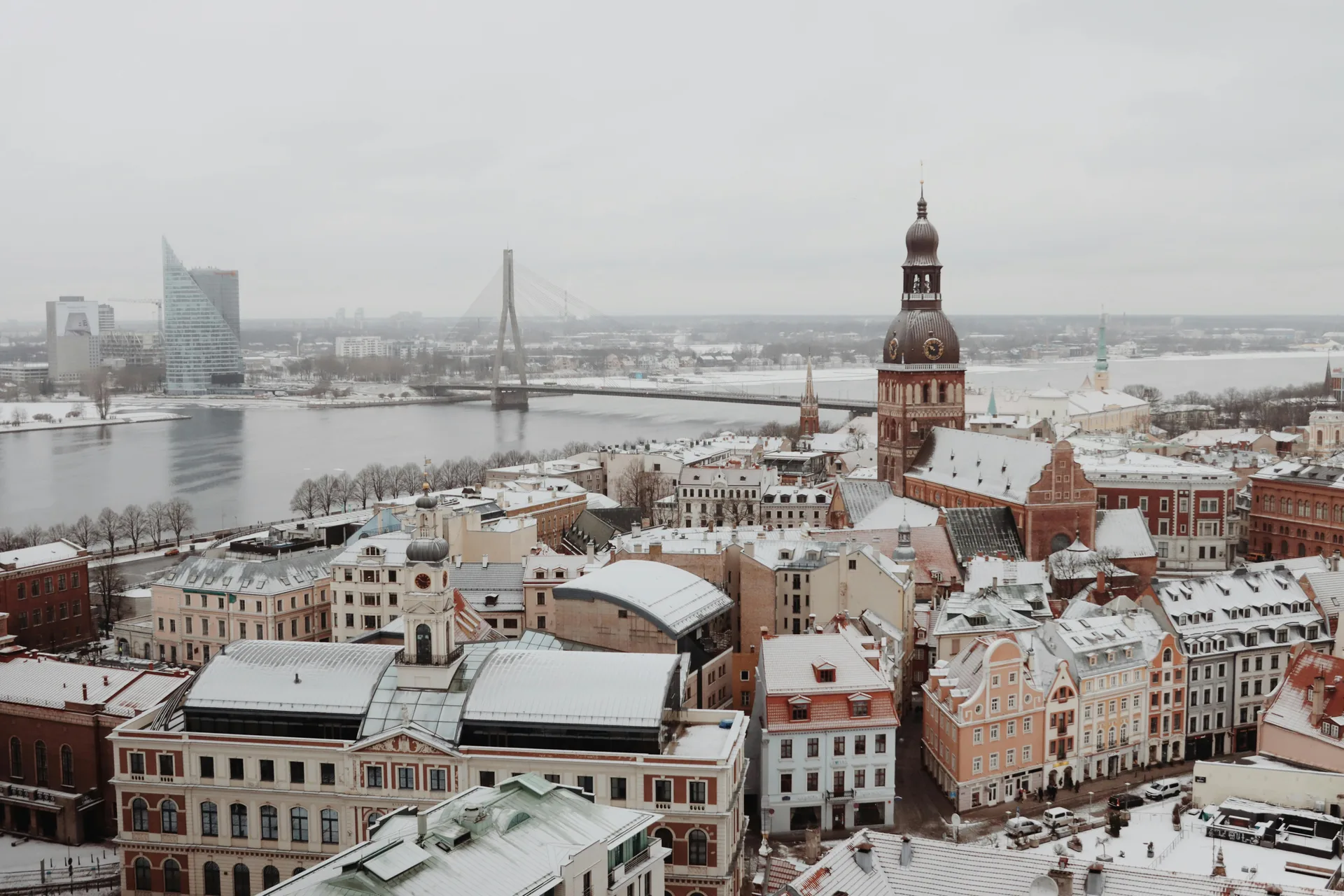
View of Riga, capital of Latvia

Moving to Latvia

The Baltic gem, simplified micro-enterprise and tax on distribution

Read the guide
European UnionCurrency: EuroMicro-enterprise 25% all-inCorporate tax 20% on distributionCapital: Riga-25/35% vs Paris

Factsheet: Latvia

Latvia is a small Baltic state of 1.9 million inhabitants, an EU member since 2004 and a Eurozone member since 2014. Located between Estonia to the north and Lithuania to the south, it shares with its Baltic neighbors a tradition of economic openness and competitive taxation. Riga, its capital, is one of the most beautiful medieval cities in Europe and home to more than half the country's population. For those seeking to expatriate to an EU Eurozone country with simple taxation for self-employed workers and a cost of living significantly lower than France, Latvia deserves serious attention, often overshadowed by its Estonian neighbor.

🇱🇻
Latvia
The Baltic gem, simplified micro-enterprise and tax on distribution
Capital
Riga
Official language
Latvian (English common in Riga)
Currency
Euro (€)
Population
~1.9 million
Timezone
UTC+2 (UTC+3 in summer)
🇪🇺 European Union
Yes, since 2004
Digital nomad visa
No, EU free movement
Cost of living (vs Paris)
~25 to 35% cheaper

Why choose Latvia?

Latvia offers a unique profile among the Baltic states: Eurozone membership, EU belonging, a very simple micro-enterprise regime with an all-in rate of 25%, and a corporate system where tax is only due upon distribution of profits. Riga is a city of remarkable beauty, with a rich cultural life and still moderate cost of living. Here are the six main advantages of Latvia for a French expat.

🌍
EU member and Eurozone
Full freedom of movement for EU citizens, euro currency, European legal protection. No currency risk, no visa required.
📊
Micro-enterprise at 25% all-in
The Latvian micro-enterprise regime allows self-employed individuals to pay a single rate of 25% on gross revenue, covering both income tax and social contributions. Simple, predictable, no complex accounting.
🏢
Corporate tax 20% only on distributed profits
Like neighboring Estonia, Latvia adopted since 2018 a corporate tax system where tax is only due when dividends are distributed. Reinvested profits remain untaxed.
🏰
Riga — Architectural jewel of the Baltics
UNESCO-listed capital for its exceptional Art Nouveau architecture, Riga is a vibrant, multicultural city of rare beauty for a capital of its size.
💰
Cost of living 25 to 35% lower than Paris
Housing, food, restaurants, transport — everything is significantly cheaper than France, with infrastructure and service quality approaching Western European standards.
✈️
Good connectivity to France
Direct flights Paris-Riga available (Air Baltic, European hub connections). About 2.5 to 3 hours flying from Paris. Reasonable fares for trips back to France.

Visa & Residence

Latvia is an EU and Schengen area member. French citizens benefit from free movement and can settle in Latvia without a visa or prior procedure. After three months, registration with local authorities is necessary to formalize residency.

EU free movement — No visa required

As a French national, you can enter and settle in Latvia freely, without a visa. After 3 months of stay, you must register with the Office of Citizenship and Migration Affairs (Pilsonibas un migracijas lietu parvalde, PMLP). Registration provides access to a personal residence number, essential for opening a bank account, subscribing to services and filing taxes. The procedure is simple, quota-free and accessible to anyone with housing and sufficient resources.

Duration
Unlimited (EU)
Min. income
No formal minimum required
Timeline
Registration in a few days
Target
Free or minimal administrative fees

Permanent residency after 5 years

After 5 years of continuous legal residence, European nationals can apply for a permanent residence card in Latvia. This card provides enhanced legal security and facilitates access to public services. No language or income test is required for EU citizens.

Registration and resident number

Registration with the PMLP allows you to obtain a personal number (personas kods), equivalent to a social security number. It is required for opening a bank account at a traditional Latvian bank, filing taxes and accessing public health services. The procedure can be done in person or online with a European electronic ID.

Required documents: valid passport or ID card, proof of housing in Latvia (lease or property deed). Free procedure, processing in a few business days.

Cost of living

Latvia is one of the cheapest Eurozone countries, making it a particularly attractive destination for expats whose income is in euros. Riga has the highest prices in the country, but still remains 25 to 35% cheaper than Paris. Other cities like Jurmala (seaside resort) or Liepaja offer even more moderate rates. Food, dining out and daily services remain very accessible.

Estimated monthly budget: 1,000 - 1,700 EUR/month

Expense Monthly amount
Rent 1 bed, city center Riga 550 - 850 EUR
Rent 1 bed, suburbs or other city 350 - 550 EUR
Groceries 150 - 250 EUR
Restaurants 100 - 180 EUR
Public transport (monthly pass) 20 - 30 EUR
Fiber internet 15 - 25 EUR
Private health insurance 40 - 100 EUR

📊 Taxation

Latvia profoundly simplified its tax system in the 2010s. The most notable point for entrepreneurs is the adoption, since 2018, of a corporate tax regime modeled on Estonia: tax is only due when profits are distributed. For self-employed individuals, the micro-enterprise regime offers an all-in flat tax of 25%, with no complex accounting. The France-Latvia tax treaty prevents double taxation.

Micro-enterprise — 25% all-in
Single rate of 25% on gross revenue, covering income tax and social contributions. Accessible to self-employed with turnover up to 25,000 EUR/year. No complex accounting required.
Income tax (IT)
Progressive rate of 20% up to 20,004 EUR annually, 23% between 20,004 EUR and 78,100 EUR, and 31% above. Applicable outside the micro-enterprise regime.
Corporate tax (CIT) — 20% on distribution
Inspired by the Estonian model: 0% on reinvested profits. The 20% corporate tax is only due upon dividend distribution. A major advantage for entrepreneurs who reinvest their profits.
Standard VAT
21%. Reduced rate of 12% on certain goods and services (medicines, books, hotels).
France-Latvia tax treaty
Double taxation avoided. Income taxable in Latvia only for Latvian tax residents.

🚀 For entrepreneurs

Latvia is an interesting country for entrepreneurs thanks to its simplified micro-enterprise regime and its Estonian-model corporate tax (0% on reinvested profits). Riga has a developing startup ecosystem, particularly in the fintech, tech and business services sectors. Company formation is fast and inexpensive.

Latvian micro-enterprise — The simplest regime
25% all-in flat tax (income tax + social contributions) on gross revenue. Accessible up to 25,000 EUR annual turnover. Ideal for freelancers and self-employed in the startup phase.
SIA — Equivalent of an LLC
The SIA (Sabiedriba ar ierobezotu atbildibu) is the most common corporate form. Symbolic minimum capital of 1 EUR (simplified regime) or 2,800 EUR (standard regime). Corporate tax at 20% only on distribution.
0% on reinvested profits
As in Estonia, profits left in the company are not taxed. The 20% corporate tax is only due upon dividend payment. An ideal framework for growing a business.
Growing fintech and tech ecosystem
Riga hosts several European tech and fintech hubs. Latvia is known for its financial sector (several international banks) and its rapidly developing tech community.

❤️ Healthcare

Latvia has a public health system funded by social contributions. Public coverage is accessible to contributing residents, but the public sector sometimes suffers from underfunding and waiting times. Most expats opt for supplementary private health insurance, much cheaper than in France, which provides access to quality private clinics in Riga.

Public system
Accessible to residents who contribute to Latvian social insurance. Basic coverage available, but variable quality depending on specialty. Sometimes long waiting times.
Private health insurance recommended
40 to 100 EUR/month for adequate private coverage. Bupa, Cigna Global, Allianz Care or local insurers like BTA. Fast access to modern private clinics in Riga.
Private clinics in Riga
Several good-quality private clinics available in Riga (VESELIBAS CENTRS AURA, Capital Clinic Riga). Consultations at 30-60 EUR without coverage.
Dental care
Good quality at very accessible rates. Latvian private dentists are significantly cheaper than in France, and of good quality for routine care.

Where to live

Latvia is a small country where Riga concentrates the bulk of economic and cultural life. Other cities offer calmer atmospheres, close to nature and the Baltic Sea, ideal for remote workers and families seeking a more tranquil pace of life.

Riga
Riga
UNESCO-listed capital, exceptional Art Nouveau, dynamic cultural scene, international community present. Growing tech and fintech hub. Rent 550-850 EUR/month city center.
Best for: Entrepreneurs, remote workers, creatives
Jurmala
Jurmala
Seaside resort 30 km from Riga, Baltic beaches, elegant villas, quiet residential atmosphere. Popular with families and wealthy expats.
Best for: Families, remote workers seeking calm and nature
Liepaja
Liepaja
Second city of the country, Baltic port, known for its music scene and cultural life. Very affordable rents, calm pace of life.
Best for: Creatives, remote workers, limited budget
Daugavpils
Daugavpils
Second largest city by population, near the Lithuanian and Belarusian borders. Heavily Russian-speaking, among the lowest rents in the country. Less international but authentic.
Best for: Limited budget, adventurers of local integration

Drawbacks to know

❄️
Harsh and dark winters
Like its Baltic neighbors, Latvia endures long and harsh winters with little daylight. Temperatures can drop to -15 or -20 degrees Celsius. An important factor to consider.
🗣️
Very difficult Latvian language
Latvian is a rare Baltic language, unrelated to commonly known European languages. English is common in Riga, but the language barrier remains an obstacle for deep integration.
📉
Declining population
Latvia has lost nearly a quarter of its population since 1991, primarily through emigration to other EU countries. This phenomenon affects economic dynamics and certain service sectors.
🌐
Still limited startup ecosystem
Riga has a growing tech scene, but remains well behind Tallinn or Vilnius in terms of startup density, investment funds and tech job opportunities.
🤝
Demanding social integration
Latvians have a reserved culture. The Russian-speaking community represents nearly 25% of the population, creating a complex social dynamic. Expats often integrate slowly.
✈️
Less dense international connections
Riga has an international airport with direct links to Paris, but the flight offer is less dense than from Tallinn or Vilnius. Transit options may extend travel times.

Frequently asked questions

Is Latvia really in the Eurozone? +
Yes, Latvia adopted the euro on January 1, 2014. This is a significant advantage for expats whose income is in euros: no currency risk, no conversion fees, and full monetary integration within the European space. SEPA transfers work normally.
How does the Latvian micro-enterprise regime work? +
The Latvian micro-enterprise regime allows self-employed individuals to pay a single rate of 25% on gross revenue, covering both income tax and social contributions (pension, health). This regime is accessible up to 25,000 EUR annual turnover. It requires no complex accounting. Above the threshold, other regimes (progressive income tax or company) become mandatory.
How does Latvian corporate tax work in practice? +
Since 2018, Latvia has adopted the same principle as Estonia: corporate tax (20%) is only due when profits are distributed as dividends. As long as profits remain in the company (for reinvestment, equipment purchases, business development), no corporate tax is paid. This logic promotes business growth and capital accumulation.
Is it easy to open a bank account in Latvia? +
Traditional Latvian banks (Citadele, SEB, Swedbank) are accessible to European residents but may require several documents. The process is simpler after registration and obtaining the resident number (personas kods). In practice, many expats use Wise or Revolut for daily needs, and only open a local account when necessary for their Latvian professional activity.
What is the difference between Latvia and Estonia for an expat? +
Both countries share a similar tax approach for companies (tax only on distribution) and EU/Eurozone membership. Estonia stands out for its exceptional digital advancement (e-Residency, 100% online public services) and very dense startup ecosystem. Latvia offers a slightly lower cost of living and Riga is a capital of remarkable architectural beauty. For a highly digital entrepreneur, Estonia often has a head start. For a balanced lifestyle in an affordable European setting, Latvia is an excellent option.
Is Latvia suitable for families? +
Yes, Latvia offers a decent environment for families, with a solid public education system, high safety and plentiful green spaces. English-speaking international schools exist in Riga. The reduced cost of living allows better purchasing power for families. The main challenge remains the Latvian language, especially for children's schooling in the public system.
How do you become a Latvian tax resident? +
You become a Latvian tax resident by officially registering as a resident and spending more than 183 days per year in Latvia. The process involves registering with the PMLP, obtaining a personas kods, declaring your tax non-residence in France, and declaring your worldwide income in Latvia. An accountant specialized in Franco-Latvian taxation is recommended to avoid errors during the transition.

Explore other destinations

Compare with other countries that might suit you.